
Module 3: Organizing your time
When it comes to structuring your study routine for dual degree preparation, the right balance between discipline and flexibility can make all the difference. Let’s explore how you can navigate this aspect of your journey effectively.
Finding Your Balance
While more structured approaches like teaching certifications involve fixed time blocks and rigorous schedules, Sciences Po dual degree preparation offers a bit more flexibility. It all boils down to what suits you best: a fixed timetable that outlines your work tasks for each specific moment, or a more adaptable approach that aligns with your personal motivation.
The Pros and Cons
A structured routine, where you allocate specific time slots for designated tasks, has its advantages. It keeps you accountable and ensures steady progress. For instance, designating Tuesdays for current events and Thursdays for self-analysis sets a clear framework for advancement. Yet, this approach might feel reminiscent of school, possibly triggering frustration on days when you’re not in sync with the assigned task.
On the flip side, a completely flexible schedule allows you to engage in tasks based on your mood and inclination. However, it’s a double-edged sword, as too much flexibility can lead to procrastination or lack of direction.
How you will choose to work and organize your time will depend entirely on you – however, if you feel lost about which method to use, come talk to us!
A Balanced Approach
Our suggested approach lies in the middle ground, offering you the best of both worlds. Here’s how it works:
Weekly Time Slots
Begin by carving out weekly time slots dedicated to your dual degree preparation. Start conservatively, perhaps with four hours a week, and gradually expand as you grow more comfortable.
Task Flexibility within Slots
Every week, outline a general sense of tasks you want to accomplish. These can span recurring tasks (like staying updated with current events) or specific goals (such as completing course exercises or crafting detailed subject notes).
Choosing Your Task
As you approach a designated time slot, you’ll have the freedom to choose from the outlined tasks. Let’s say you’ve set aside Monday, Wednesday, and Friday evenings from 6 to 8 p.m. for dual degree preparation.
- On Sunday, before the week begins, decide on the tasks you aim to tackle: for instance, contacting three individuals and creating comprehensive notes on a key topic like the independence of the judiciary branch.
- As Monday evening arrives, assess your mood, energy level, and circumstances. You then choose the task that resonates most with you in that moment. This flexibility empowers you to optimize your productivity.
- On nights when you’re drained and drafting seems daunting, you could switch gears and enjoy a movie from your recommended list. Remember, even small achievements contribute to progress.
In essence, this approach creates structure while retaining room for adaptability. It ensures that you make steady headway while respecting your own rhythms and preferences.
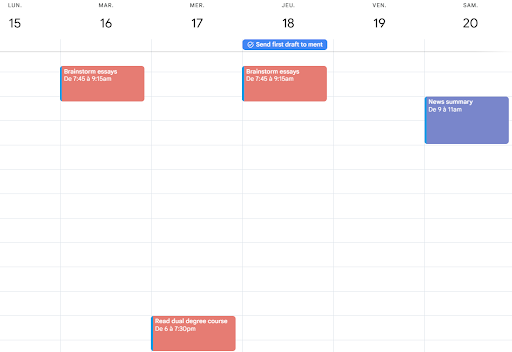
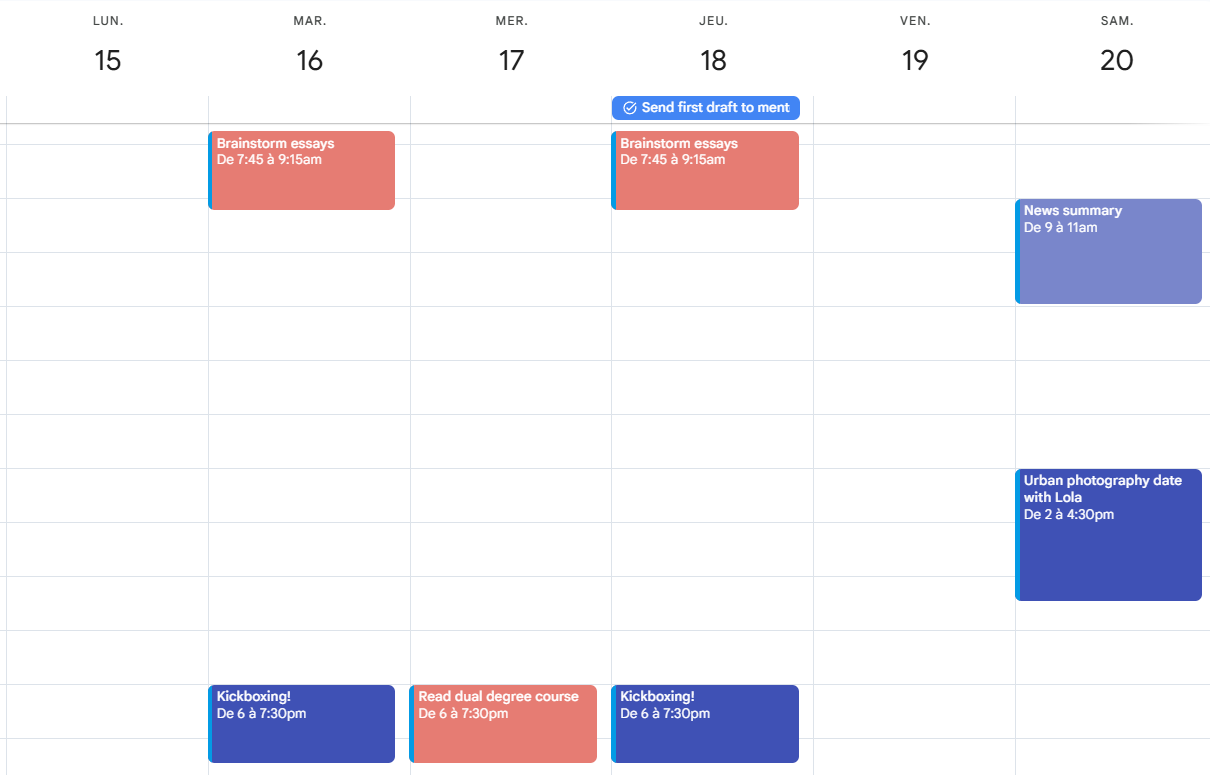
Tip: You can use Google calendar to organize your slots and centralize your tasks. It is a very effective way to keep track of deadlines and get an overview of the upcoming week.
Striking a Productive Balance
To sum it up, your dual degree journey requires effective time management. This involves defining your weekly slots, outlining your tasks, and embracing the freedom to choose. Whether you lean toward structure or flexibility, finding the equilibrium that resonates with you will be the key to a successful and fulfilling preparation process.
Embrace the Learning Journey
One important thing to remember is that finding your work rhythm and style is a gradual process. So, if you don’t immediately find the perfect fit, don’t worry. Experiment, adjust, and discover what suits you best. This process is all about self-exploration – a valuable aspect of this application process. As your understanding of the dual degree deepens, so will your grasp of effective time management. Embrace the freedom to try different strategies and adapt as you learn what resonates with you. This journey is not just about the destination; it’s a chance for personal growth and self-discovery.
Navigating Time Allocation
Determining how much time to allocate to your dual degree preparation is a fundamental consideration. Think of it as akin to investing in a protective jacket before embarking on a risky motorcycle ride. Just as you value your life when making such decisions, how much you want to excel in your dual degree journey will guide your time commitment.
However, we must stress two key limits:
- Physical and Mental Well-being: Never compromise on essential needs like sleep, meals, and mental rest. Your comfort and health are paramount.
- Strong First Quarter: Achieving a robust start in your senior year is vital for eligibility. Impressive grades and evaluations during this term can sway the jury in your favor. Given that most dual degree application deadlines fall between late November and mid-January, this initial quarter is when the bulk of your preparation work and interview readiness will be crucial.
Balancing your dual degree preparation with senior year commitments requires careful consideration. Remember that quality is better than quantity. A productive, thoughtful 2 hours will bring much more than 4 hours without a clear goal.
Tip: If you struggle to find time to brainstorm your essays, remember that doing a little bit everyday helps more than a couple long sessions. A method that can help you make significant progress in a limited amount of time is the Free Writing Approach. Setting a timer for just 10-15 minutes a day and brainstorming ideas can help you reflect without pressure.
Allocate Time to Rest
As deadlines approach, you might forget to dedicate enough time to rest and leisure. This is not a smart approach. Resting and doing activities you enjoy are key to keeping you balanced and healthy.
When planning your week, make sure to save dedicated time for hobbies, sport, social activities and rest. They will keep you motivated and will allow your brain and body to relax.
Maximizing Efficiency: Focus and Materials for Dual Degrees
Efficiency in your dual degree preparation is paramount. To ensure optimal productivity, there are certain strategies to embrace and pitfalls to avoid. Let’s delve into a few non-exhaustive tips that address common mistakes and help you streamline your work process for your dual degree endeavors.
Create an Ideal Work Environment – Material Considerations
Where you work matters just as much as what you work on. Whether it’s at a table, desk, library, or even comfortably lying on your bed, finding an environment that suits your best thinking is key. Different people thrive in different settings; the crucial factor is being in a place where you can focus and concentrate. While some might excel in a quiet library, others might need the buzz of a café. Similarly, the presence or absence of background music is a personal choice. Determine what surroundings allow you to be fully present and devote 100% of your attention to your tasks.
Eliminate Distractions – Phone Off, Focus On
In a world where the phone is both a blessing and a curse, discipline is essential, especially during exam preparation. Research indicates that attention spans have dwindled in recent years due to constant digital interruptions. While your phone has its place, it’s advisable to turn it off or put it on silent mode during your focused study sessions. Notifications and the urge to switch between tasks every few minutes can disrupt your flow. If you know (or experience) that you cannot resist the urge to look at your phone every ten minutes, ask a friend or family member to take it and only give it back to you after the timeslot you’ve allocated for your preparation.
Prioritize your studies over distracting notifications, and your learning will benefit significantly.
Select the Right Materials for the Task
Choosing the appropriate materials can significantly impact your learning effectiveness. Generally, working with paper enhances cognitive engagement compared to digital screens. The tactile experience of reading on paper and jotting down notes by hand can lead to deeper comprehension and fewer distractions. However, digital platforms offer advantages too, such as faster note-taking and convenient writing. Tailor your materials to the task at hand; alternate between screens and paper as needed. For exercises requiring contemplation and reflection, like self-introspection for your dual degree motivations, opting for pen and paper might enhance your insights.
Phones, however, should be strictly excluded from your study space. The lure of a smartphone can hinder your focus and sabotage your efficiency. Numerous reasons contribute to our inability to concentrate effectively on phones. For instance, the pre-bounce rate on mobile websites underscores our impatience: users often exit a site before it loads, just due to a few seconds’ delay. Recognize that phones hinder, rather than aid, focused work.
By refining your work environment, limiting distractions, and thoughtfully selecting materials, you can drastically boost your efficiency. These practices set the stage for effective learning and deep engagement, ultimately enhancing your readiness for the challenges of your dual degree journey ahead.
Enjoy the Journey
Another pivotal aspect of maximizing your efficiency in dual degree preparation is finding enjoyment in your tasks. This principle, as reiterated throughout our guidance, holds immense value. It’s a simple equation: the more you relish what you read, watch, or engage with, the better you comprehend, retain, reflect, and connect the information.
Rather than slogging through material that bores you or forcing yourself to cover classics that hold little personal interest, prioritize subjects that genuinely captivate you while still contributing to your intellectual growth. The approach we advocate aligns general knowledge and current affairs with your passions for a reason – because it works! Genuine interest leads to deeper engagement and effective learning.
Consistency and Revisitation
Here, we unveil the fifth pivotal tip, perhaps one of the most crucial in this entire course: maintain consistent effort and revisit the same subjects over time. Musicians understand this concept inherently. Regular, shorter sessions over consecutive days trump marathon study sessions. The strategy of allocating six hours to one subject in a single day might earn a temporary badge of honor, but its impact is fleeting.
This approach isn’t about morality or adhering to a school-enforced pattern; it’s about pure efficiency and optimizing your path to a successful dual degree endeavor. Science demonstrates that the brain retains information more effectively through regular revisitation. Our advice stands: whether you’re studying a subject, introspecting, crafting your application, or even learning a new language or instrument – commit to consistent, spaced effort. By doing so, you’ll save time and enhance your learning experience through meaningful repetition.
Embrace Collaboration
Lastly, don’t underestimate the power of collaborative learning. There are three compelling reasons to embrace collaboration:
- Collective Intelligence: Working together sparks diverse interpretations and ideas, fostering intellectual stimulation and growth.
- Motivation and Peer Pressure: Partners in your journey offer motivation and a positive form of peer pressure. Committing to study sessions with a friend can drive you to work even when motivation wanes.
- Mutual Support: We all face moments of low energy or motivation. Having a companion who understands the challenges and can uplift you during such times is invaluable.
Your peers from your tutor group are a fantastic starting point for collaboration. These individuals share your dual degree aspirations and understand the journey firsthand. Dedicated “peer-review” times will be provided for structured collaboration, but don’t hesitate to take initiative and schedule your own sessions. If logistics permit, consider in-person meetings to deepen the collaborative experience.
Our recommendation is clear: don’t embark on your dual degree preparation solo. Form a study group of two or three like-minded individuals to share the journey. The benefits are undeniable, offering a supportive network, varied perspectives, and collective motivation that can elevate your efficiency and overall learning experience.
Managing Your Energy & Embracing Frustration
Now, let’s delve into effectively managing your energy and handling moments of frustration during your dual degree preparation. Recognizing that we are humans, not machines, is crucial. Our emotional states, motivations, and energy levels vary. Here are some essential tips to navigate this aspect of your journey:
Divide Your Efforts
Our brains have a limited capacity for focused work. Whether you’re reading, organizing ideas, or writing, there’s a threshold beyond which your prefrontal cortex starts to lose efficiency. This limit might be around 1 hour and 30 minutes for some, while for others it’s closer to 2 hours. The key is to understand your own rhythm and work within it. Pushing yourself beyond this point yields diminishing returns and drains your energy.
Observe Signs of Fatigue
Pay attention to signs of both physical and mental fatigue. These cues signal when it’s time to take a break.
Prioritize Rest
Similar to physical training, mental exertion requires adequate rest. Sustained work without breaks can be counterproductive. While boasting about marathon study sessions might stroke your ego, your brain’s prefrontal cortex doesn’t share the enthusiasm. Your mental well-being and effectiveness hinge on proper rest.
What Constitutes Rest?
Effective rest replenishes more energy than it consumes. Engaging in activities that rejuvenate your mind is vital. Spending quality time with friends, taking nature walks, or indulging in creative pursuits offers more profound restoration compared to passive activities like binge-watching TV shows.
Release Guilt
Guilt, while socially functional, becomes a hindrance when it comes to preparation. Feeling guilty about not dedicating enough time to your dual degree journey can be counterproductive. Redirect that energy towards productive actions rather than dwelling in unconstructive emotions.
Avoid Comparisons
Comparing yourself to peers is a pitfall. Every individual’s journey is unique, shaped by various factors such as concentration abilities, emotional and intellectual pace, and personal strengths. Recognize your own progress and leverage your distinctive qualities.
Embracing Frustration
Preparation might include challenging aspects that trigger frustration. This is normal. The key is to accept these moments and work through them. On days when motivation is low, opt for tasks that align with your current state. Choose activities that resonate with your mood rather than forcing unproductive efforts.
Conclusion
Managing your energy and handling frustration are integral parts of this journey. Acknowledge that these emotions are natural, and coping with them is a learning experience. It’s essential to strike a balance between work and rest, release unproductive emotions, and avoid comparing yourself to others. With practice, you’ll develop effective strategies to navigate these challenges and maintain a healthy and productive approach to your dual degree preparation. Remember, we believe in your capabilities!
Exercise 1: Finding Your Concentration Rhythm
Understanding your concentration rhythm is essential for effective dual degree preparation. Follow these steps to discover your optimal work pattern:
- Set Up a Timer: For various preparation activities, use a timer to track your progress. Categorize activities like reading news, watching videos, internet research, introspection, and creating materials (note-taking, writing, etc.).
- Observe Fatigue: As you engage in each activity, pay attention to signs of physical and mental fatigue. Note when you start to feel less productive or focused.
- Identify Slowdown Points: Pinpoint the moments when your progress slows down. This indicates your brain’s working capacity and helps you understand your concentration limits for each task.
- Determine Refreshment Time: As a corollary, analyze how much time it takes for you to feel refreshed and ready to resume a task. Does a short break of 15 minutes suffice, or do you need an hour? Identifying this interval will aid in planning your work sessions effectively.
- Identify Optimal Activities: While observing your rhythm, also identify which activities allow you to perform at your best. Recognize tasks that naturally align with your concentration peaks and plan your schedule accordingly.
By completing this exercise, you’ll gain valuable insights into your concentration patterns. This knowledge will guide your time management strategy, ensuring that you allocate tasks appropriately based on your natural work rhythms. Remember, understanding your personal rhythm contributes to better efficiency and a more enjoyable preparation journey.
Work Hard vs. Work Smart: A New Perspective
In examining our approach to work, it’s important to acknowledge societal influences that emphasize the value of “hard work.” Whether rooted in historical notions like the Biblical concept of toil or propagated through stereotypes of relentless American success stories, the idea of grinding and persevering has been deeply ingrained in our culture. However, upon closer examination, this traditional philosophy might not be as effective as it seems.
The grind-it-out mentality, where effort feels like a constant battle, often leads to burnout and reduced productivity. While it’s normal to face challenges and momentarily uncomfortable tasks, persistently wrestling with your work suggests something might be amiss.
Instead of embracing this arduous approach, try to adopt a paradigm shift towards working in harmony with your natural inclinations. This philosophy aligns with the concept of “going with the flow,” often found in Eastern philosophies like Taoism. Rather than battling against the current, why not let the river guide us?
If your preparation for dual degrees constantly feels like an uphill struggle, it’s worth considering whether you’re on the right path. Most of the time, preparing for dual degrees shouldn’t feel like a burdensome chore. It should be a process that feels light, enjoyable, and aligned with your interests. The distinction lies in the nature of the work itself.
Consider the example of reading challenging texts. If you’re forcing yourself through materials that don’t genuinely resonate with you, it’s likely to feel like hard work. On the other hand, immersing yourself in subjects that naturally intrigue you can transform the process into something enjoyable.
The key is finding the subjects and activities that resonate with your natural curiosity. Enjoyable work isn’t about consciously grinding away for hours; it’s about engaging in activities you’d willingly spend extended time on because they genuinely interest you. Instead of working hard, the focus should shift to working smart.
Furthermore, if you discover that certain readings or topics related to your dual degree program don’t captivate you as much as anticipated, it might be time to reevaluate your path. Authentic resonance should be at the core of your pursuit. Engaging with subjects that truly resonate makes investing time in them not only easier but also more fulfilling.
So, let go of the notion that hard work is the only path to success. Embrace the energy and enthusiasm that naturally arise from pursuing subjects that genuinely intrigue you. Remember, it’s not about slogging through, but about immersing yourself in learning, enrichment, contemplation, and discussion. Leverage your authentic interests to engage the jury and showcase your genuine curiosity and intrigue. This approach, rooted in resonance and authenticity, is a pathway to both effective preparation and a fulfilling journey.