
Module 1: Understanding the Interview’s Objectives
To excel in your interview, it’s essential to grasp the criteria on which you’ll be assessed. So, what are the key areas of focus for this interview? In our perspective, a substantial part of the answer can be found on the respective Sciences Po dual degree websites, particularly in the admission interview section. Here are some examples:
Sciences Po/UBC:
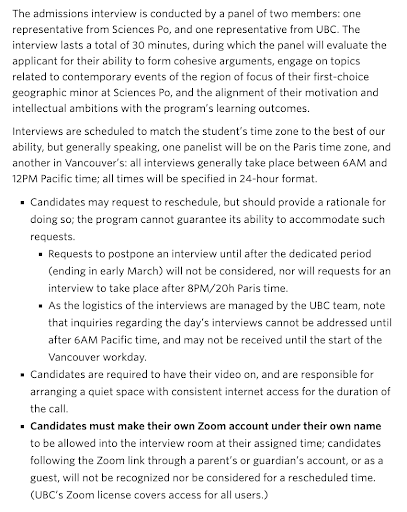
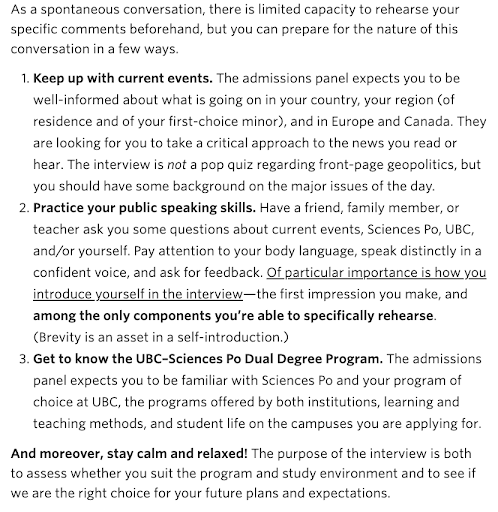
Sciences Po/Columbia:
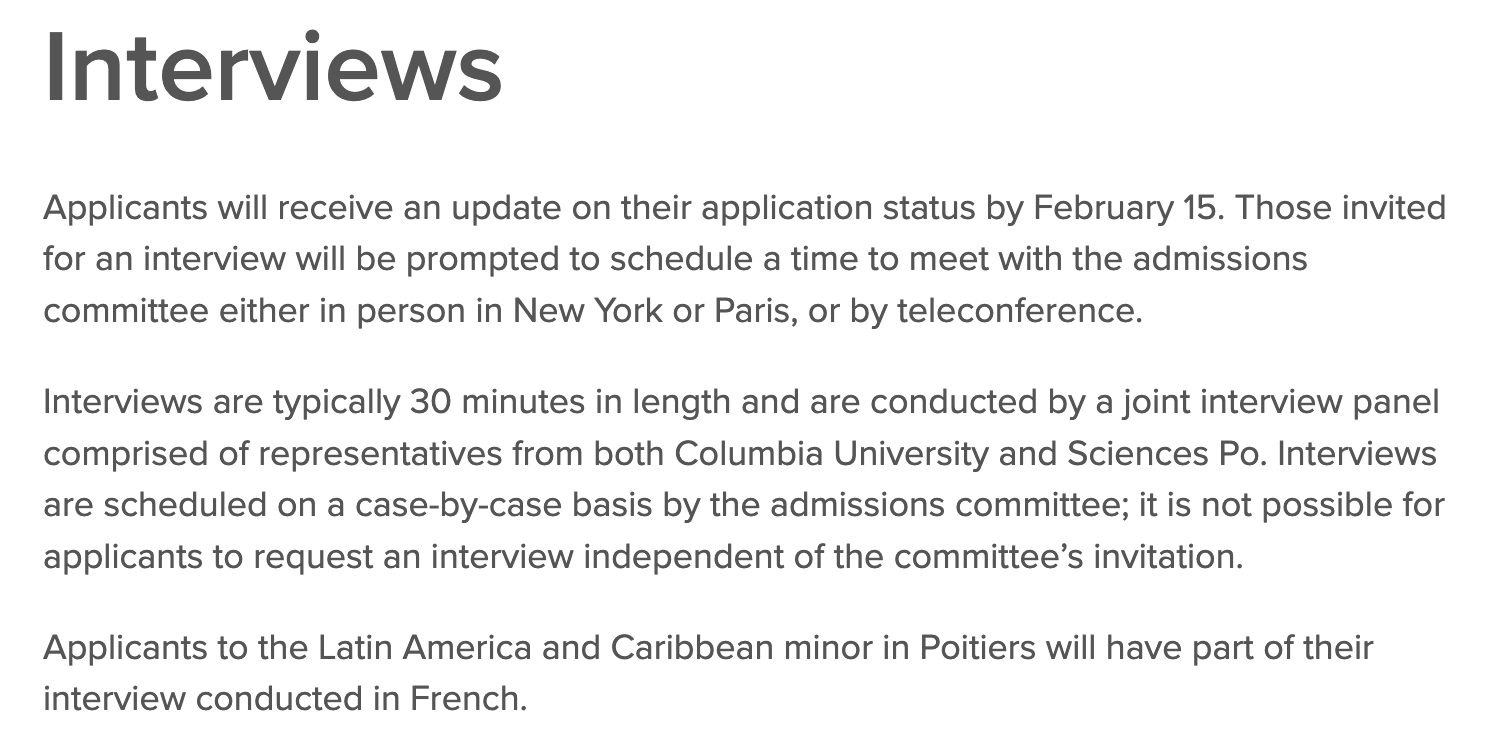
( https://sciencespo.gs.columbia.edu/content/interviews )
Sciences Po/UC Berkeley:
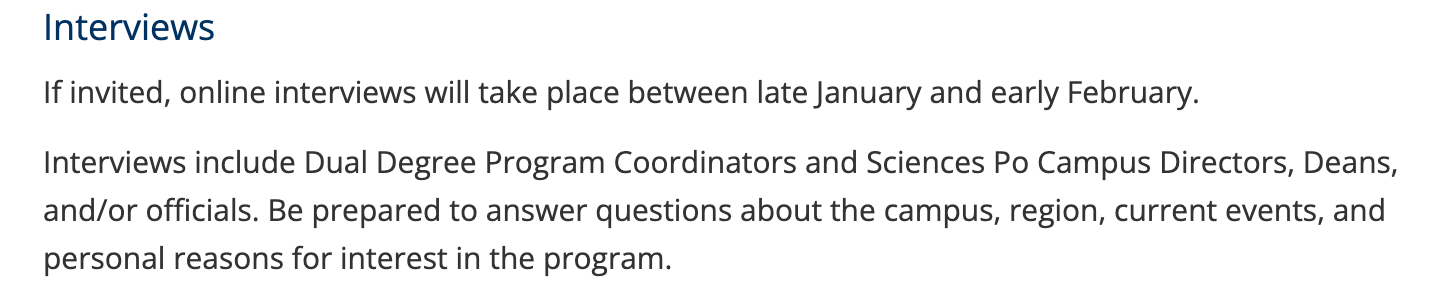
( https://sciencespo.berkeley.edu/admissions )
Sciences Po (for Parcoursup dual degree program):
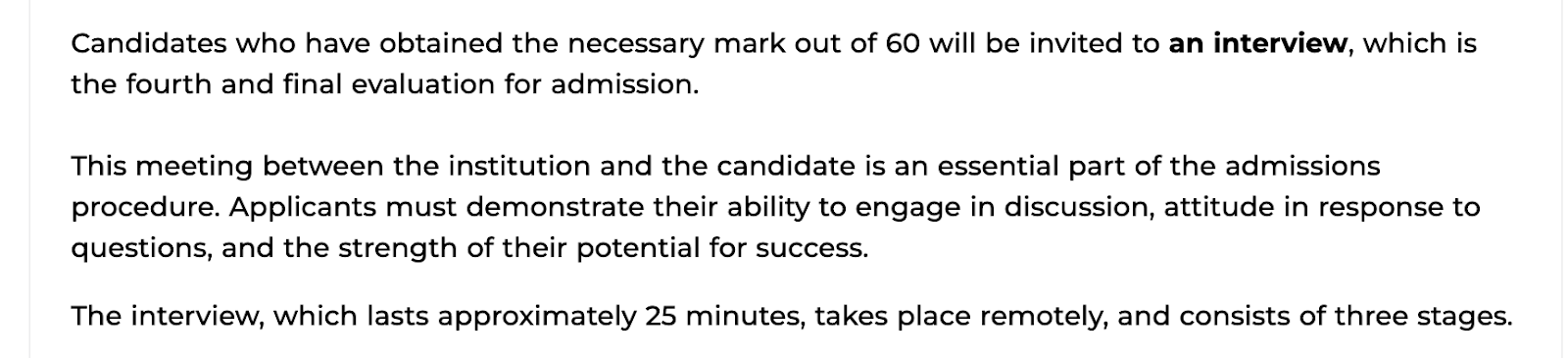
The interview will aim to evaluate various aspects, including:
Mastery of Oral Expression
At this stage in your education, you’re expected to communicate not just fluently, but with precision, especially in academic or formal settings. During the Sciences Po dual degree interview, your ability to express complex ideas clearly and thoughtfully is under close scrutiny. This goes beyond speaking confidently – it’s about choosing the right words, structuring your thoughts coherently, and demonstrating that you’re intellectually mature enough to handle university-level discussion, particularly in fields like political science, sociology, history, or international relations.
What does this look like in practice? Instead of vague or overly general statements, your speech should reflect a command of specific vocabulary and analytical phrasing.
💡 Illustration
Rather than saying “I’m really interested in politics”, choose to say “I’m particularly drawn to comparative political systems, and I’ve been exploring how semi-presidential regimes like France’s Fifth Republic balance executive and legislative powers”.
💡 Illustration
Instead of “I care about the environment”, try “My interest lies in environmental policy, particularly how international institutions like the European Union enforce climate regulations through mechanisms such as the Green Deal”.
These aren’t just stylistic – they sow that you think critically and can speak the language of social sciences. It’s also about being able to reformulate or elaborate when asked a follow-up question, demonstrating that your ideas are more than rehearsed texts.
Applicant’s Motivation
The Sciences Po dual degree interview is primarily designed to evaluate who you are, what drives you, and how clearly you’ve thought through your academic and professional journey. The committee isn’t looking for prestige-chasers or students who applied ‘just in case’. They want to admit candidates who show genuine interest in the specificities of the dual degree – both in structure and its long-term relevance to their goals.
This means your application has to be more than, “Sciences Po is a top school”.
Instead, you need to articulate 1. Why this dual degree in particular, 2. Why the two institutions involved, 3. How does this program match your academic interests and career plans.
💡 Illustration
If you’re applying to the Sciences Po – UC Berkeley dual degree, don’t just say you’re interested in international relations. Instead, explain how the program’s transatlantic dimension aligns with your goal of working in international diplomacy, and how the exposure to two academic cultures will give you the cross-cultural tools needed for a future in the UN or national diplomacy. You could say something like “I’m particularly interested in the intersection of security studies and international law, and the dual degree between Sciences Po and UCL Berkeley offers a rare opportunity to study these fields from both a European and American perspective. I see this as a foundation for a career in global conflict resolution, possibly within the European External Action Service.”
Open-Mindedness
Prove to the admission committee that you align with Sciences Po’s core academic value – interdisciplinary studies. You’re not just studying politics or law in isolation – you’re exploring how these intersect with history, sociology, economics, and even philosophy. Being open-minded means showing that you’re intellectually flexible and curious about disciplines beyond your core interests.
🌟 Tip:
In the interview, reflect on how you’ve explored different subjects and perspectives – even those that challenge your usual way of thinking.
💡 Illustration
“While my main academic interest lies in political science, I’ve also explored environmental economics to understand how economic incentives shape climate policy. This interdisciplinary approach helped me appreciate how complex policy-making really is – it’s not just political will, but also economic feasibility and public opinion that matter”.
You could also mention how reading outside your comfort zone or engaging in debates with people from different cultural or ideological backgrounds has shaped your worldview. For instance: “Participating in a debate club exposed me to libertarian viewpoints that contrasted sharply with my own. It pushed me to better understand market-based arguments for public policy and improved my ability to question my own assumptions”.
Intellectual Curiosity
At Sciences Po, success depends not only on fulfilling assignments, but on having a genuine desire to understand the world more deeply. Intellectual curiosity is about asking questions, seeking out new knowledge, and not being satisfied with surface-level explanations.
🌟 Tip:
In the interview, share concrete examples of how you pursued a topic outside the classroom.
💡 Illustration
“After studying the Cold War in history class, I was intrigued by the idea of proxy wars, so I started reading more about the Angolan civil war and the role of superpower influence in Africa. That research led me to question how Cold War dynamics still echo in modern international relations”.
💡 Illustration
“I’ve recently been reading Amartya Sen’s work on development, which shifted my understanding of poverty from a purely economic issue to one deeply linked to political freedom and public health”.
🌟 Tip:
Avoid generic claims like ‘I love reading’. Instead, show curiosity in action.
Engagement with Contemporary Issues
One of Sciences Po’s core missions is to train students to understand and address the world’s most pressing challenges – from democratic backsliding to climate change, inequality, migration, or digital governance. Showing engagement with current affairs means more than simply reading the news; it’s about analyzing what’s happening, understanding its causes, and thinking about innovative solutions.
🌟 Tip:
Bring up specific events or topics that have caught your attention recently and explain why they matter.
💡 Illustration
“I’ve been following the ongoing debates around AI regulation in the EU. I’m particularly interested in how democratic governments can create effective tech policy without stifling innovation – it’s a balancing act that says a lot about the relationship between public institutions and private power”.
💡 Illustration
“The rise of populist movements across Europe has led me to explore how economic insecurity and political distrust interact. I’ve been reading about how this trend is not just a political issue but also deeply connected to the erosion of local media and community structures”.
🌟 Tip:
Whenever possible, link these issues to your academic interests or goals within the dual degree. This shows depth and intentionality.
Critical Thinking and Ability to Develop Personal Reflection
This is arguably the most important category. Sciences Po and its partner institutions don’t want students who simply repeat what they’ve read or heard – they want individuals who analyse, question, and synthesize information to form their own informed opinions.
🌟 Tip:
Show that you’re capable of evaluating different viewpoints, recognizing nuance, and forming independent opinions.
💡 Illustration
“In discussions about climate activism, I’ve found myself torn between admiration for movements like Extinction Rebellion and concern about their strategies. On one hand, they raise critical awareness; on the other, their confrontational methods can alienate people. Reflecting on this has helped me better understand the dynamics between activism, media framing, and public opinion”.
Avoid giving simplistic, black-and-white answers. If you’re asked about a controversial issue – like migration, digital surveillance, or free speech – show that you’ve considered multiple angles.
💡 Illustration
“I believe that freedom of expression is vital to democracy, but I also think it’s important to set boundaries when it comes to hate speech. The real challenge lies in who defines those boundaries and how we ensure they aren’t used to suppress dissent”.
🌟 Tip:
This shows analytical depth and self-awareness – qualities that will make you stand out.
Adaptability and Motivation for Both Schools
This criterion is specific to dual degree applicants. You need to convey your readiness for both Sciences Po and the partner organization and demonstrate the coherence between your experiences at both institutions. The jury wants to know: Can you thrive in two academic systems, two countries, and two intellectual cultures? Have you thought seriously about what this challenge means?
🌟 Tip:
Start by showing that you understand the academic and cultural differences between the two institutions.
💡 Illustration
“Sciences Po’s seminar-style classes and emphasis on political theory complement UCL’s more research-driven approach. I’m excited about moving from Sciences Po’s structured curriculum to the broader, more flexible model at UCL, where I hope to deepen my work in environmental policy through hands-on projects”.
Also, show emotional and practical readiness for adaptation – including language, methodology, lifestyle, and workload.
💡 Illustration
“Having already lived abroad during a school exchange in Canada, I’ve learned to navigate unfamiliar academic environments and cultural expectations. I know that transitioning between French and Anglo-American academic styles will be challenging, but I see it as an opportunity to grow both personally and intellectually.”
🌟 Tip:
Don’t forget to clarify how this dual academic path aligns with your future goals.
Exercise 1:
Now that you’ve gained an understanding of the general aims shared by all dual degree interviews, visit your specific dual degree website and search for additional information regarding your particular interview process. Check for any tips or guidance they offer and identify if there is a point of contact in the admission office whom you can reach out to for further inquiries.
Module 3: The Interview Step by Step
Now that you have a grasp of the details, let’s dive into the interview itself. Sciences Po provides a fairly comprehensive outline of the oral interview. While dual degree interviews may have some flexibility and may switch between sections, this serves as a strong foundation to understand the kinds of questions you’ll encounter.
Your Presentation
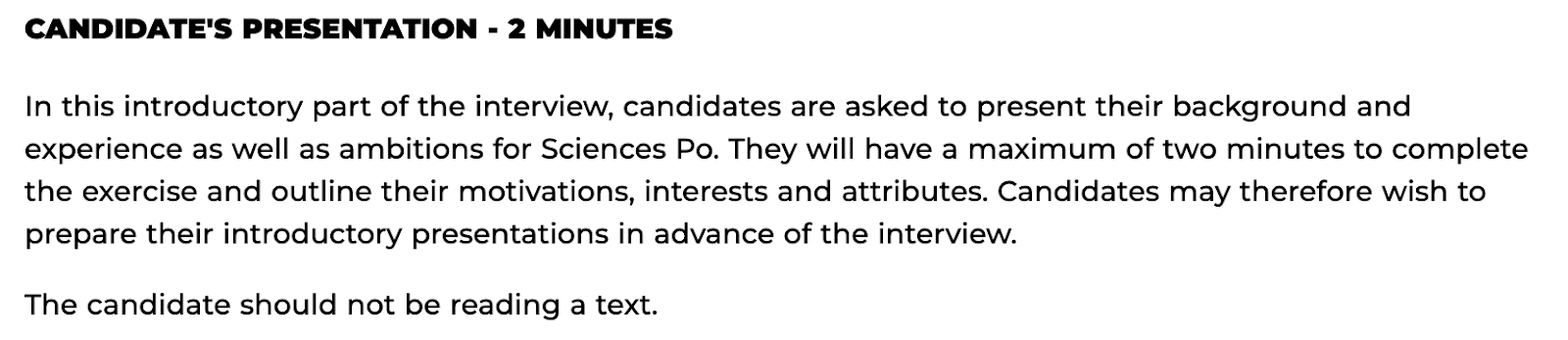
The interview begins with a short presentation about yourself, lasting no more than 2 minutes. This is your chance to briefly introduce who you are, explain why you’re applying, and highlight key parts of your background – such as specific project, experience, or achievement that you’re proud of.
You might mention a leadership role in a student organization or a research project that sparked your interest in the field.
🌟 Tip:
This is the only part of the interview you can fully prepare in advance, so use it wisely.
A well-thought-out introduction not only shows the jury that you’re motivated and well-prepared, but it also helps guide the rest of the conversation toward topics you’re comfortable discussing. Think of it as setting the tone and giving the interviewers some hooks to follow up on.
Image Analysis (for Parcoursup Dual Degrees Only)
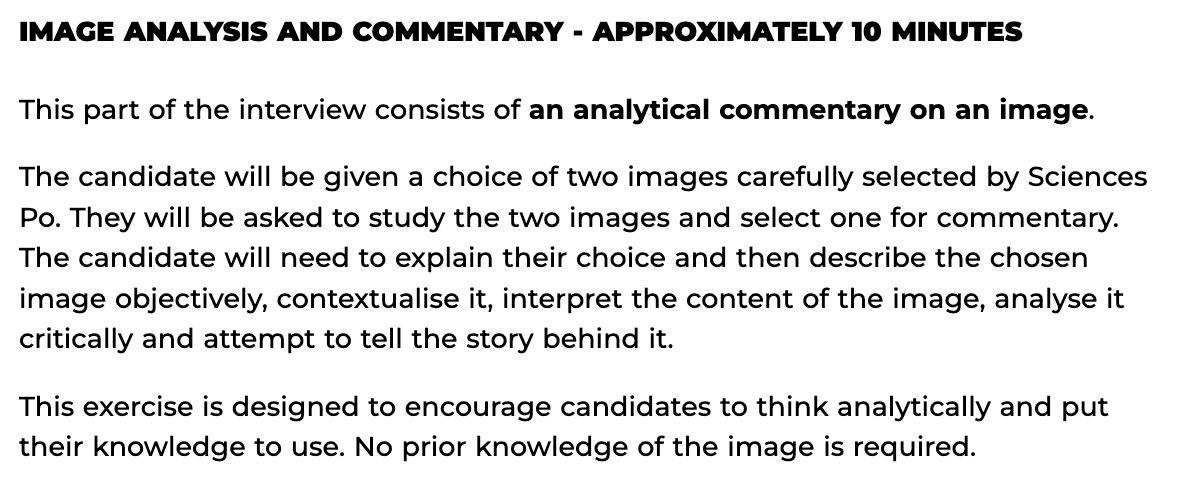
For Parcoursup dual degrees, this is the second phase of your interview and a prime opportunity to demonstrate your analytical skills to the jury. While it’s the least predictable part, with a solid method, strong background knowledge, and practice, you can leave a lasting impression. The key to this presentation is analysis. Many applicants make the mistake of merely describing the image before them without delving into a meaningful discussion. However, with thorough preparation, image analysis becomes a golden opportunity to showcase a) your analytical prowess, b) your synthesis and structuring abilities, c) your background knowledge, and even d) your motivation for the dual degree. We’ll explore this exercise in greater depth in a subsequent chapter.
Motivation Interview
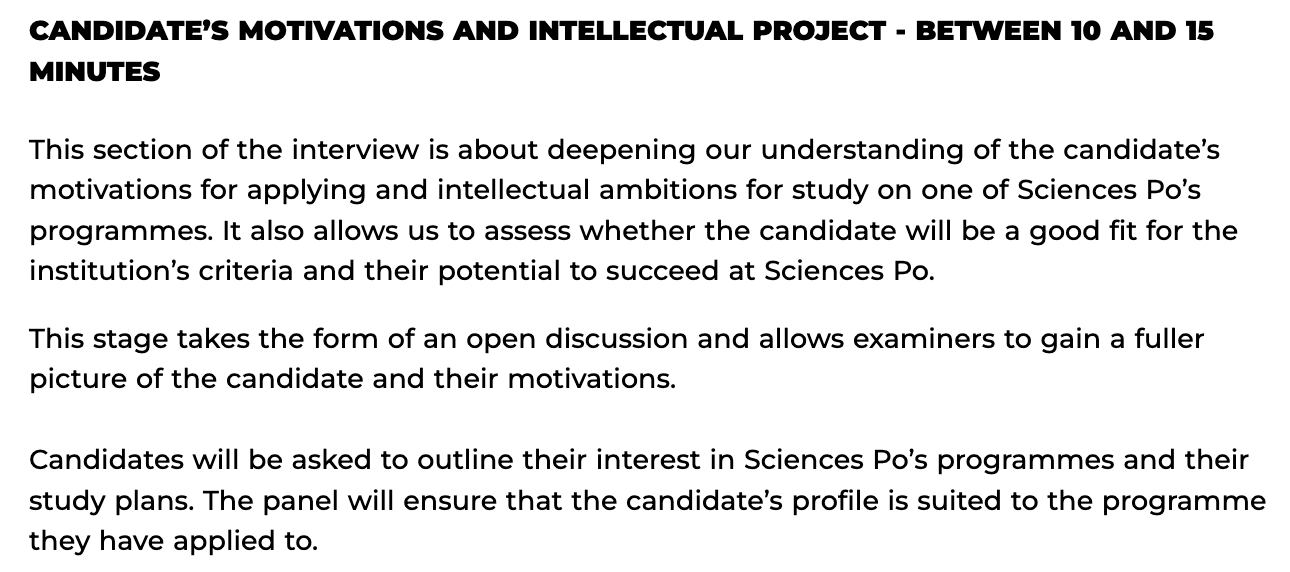
This section of the interview aligns closely with a traditional job interview format. It provides your best opportunity to demonstrate a thoughtful and sincere motivation for your chosen dual degree. It’s also a chance for you to passionately discuss experiences and interests close to your heart and showcase your knowledge of the dual degree to the jury.
Note that this part is quite similar to your personal statement – after all, it is still you we’re talking about. Therefore, all the advice we gave you before on remaining precise, concise and specific (avoiding broad, general statements such as ‘I’m interested in international relations and business’ but explaining rather how your volunteering at a local NGO made you realize how economic tools need to be combined with policy insight) is valid throughout this interview part.
🌟 Tip:
This is your moment to steer the conversation toward topics that matter to you. If you’ve read a book, written a paper, or followed a recent policy debate that’s relevant to the dual degree (and, to a certain extent, to the conversation – don’t be bringing up the latest Arte documentary only to show you’ve watched it), incorporate it in the interview – just make sure you can explain why it was meaningful to you. Demonstrating familiarity with the curriculum, the teaching approach, or even the culture of both institutions involved in the dual degree will show that you’ve done your homework.
Although this final part of the interview can be intimidating, it is often the one that applicants cherish the most because it allows for personal and dynamic dialogue with the jury. The conversation tends to flow more naturally here, especially if you’ve taken time beforehand for honest self-reflection.
✏️ NB :
All dual degree panels now have access to your file, so make sure to be tip-top ready on everything you’ve mentioned in your statement(s) (if you’ve mentioned an interest in environmental policy, don’t be surprised that they ask you about the latest EU environmental law). But after all the preparation you’ve done for your statement and self-introspection, you should know by heart what your precise interests are, how you wish to connect them to the dual degree’s program and environment – everything we’ve worked on previously. So by following the news continuously and in depth as you’ve been doing the whole year, you will naturally be ready for some precise questions.
Please note that for non-Parcoursup dual degrees, this part may place a greater emphasis on current events, as the admission committee does not assess your knowledge through image analysis. Be prepared to seamlessly transition between motivation and questions related to current events.
It happens that the jury asks you something you have mentioned nowhere in your statement(s), but that relates to your geographical area (either where you live / have done your high school years, or one of the two countries of the program).
Personal insight: during my interview for the Sciences Po – UCL admission, the jury asked me what I thought the juridical follow-up of Brexit would be on European Union countries. To be frank, I had not a clue – except for basic Brexit information, but delving into law specifics really wasn’t to my taste. I was panicking on the inside, but showed no (or little) sign of it on the outside, and managed to say something very dull, very unconvincing – the jury admitted me anyhow. This only to tell that they might ask you difficult questions to see how well you cope with them, not to check if you actually have the knowledge in that precise field of study – they know you cannot have studied everything, and that’s perfectly okay.
Conclusion and final questions
As you reach the end of your interview, the jury will likely express their appreciation and offer closing remarks. It is during this moment that you’ll have the opportunity to demonstrate your motivation and knowledge one last time.
Purpose of the Final Question
The final question in your interview serves as a chance to underscore your commitment to the jury. It signifies that your research about the school has sparked your curiosity and that you are eager to engage in a meaningful dialogue. Moreover, it’s an effective way to conclude the interview less abruptly, affording the jury the opportunity to share their thoughts.
Crafting an Effective Final Question
When formulating your final question, consider several key elements:
1. Address both schools:
Avoid asking a question that only involves Sciences Po or the partner university, and instead try to think about questions that will engage the jury in its integrality.
2. Avoid Redundancy:
Ensure that your question does not seek answers readily available on the dual degree’s website. Demonstrating thorough research is essential, and showing the jury that they need to fill in information gaps can be detrimental.
3. Avoid Over-Specificity:
Given that you don’t know who your interviewers are in advance, refrain from posing overly specific questions that they might not be equipped to answer, potentially creating discomfort. Keep your question open-ended.
4. Avoid Controversial Queries:
While the jury may inquire about your stance on current affairs, your final question isn’t intended to turn you into an interviewer. Controversial questions might not always be well-received – avoid asking them what they think about the UK leaving the EU, or whether they believe Turkey should be allowed in.
Instead, aim for a question that reflects your motivations, conveys genuine curiosity about the dual degree, and offers the jury the opportunity to express themselves, regardless of their expertise and political viewpoints. For example, a good concluding question could be “The value placed by the dual degree in critical thinking particularly attracts me to this program. How do both schools ensure a diversity of opinions with their teaching staff to ensure fruitful dialogue?”
By thoughtfully crafting your final question, you can leave a lasting impression and conclude your interview on a high note.